The brain – structure and function
The brain, together with the spinal cord, makes up the nerve control centre which controls all our body’s functions.
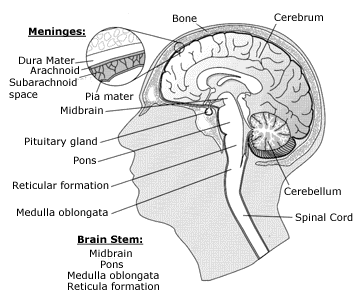
Between the surfaces of the brain and the skull there are three layers of membrane called the meninges, which completely cover the brain and spinal cord (see diagram).
Between two of these layers is a space called the subarachnoid space. The subarachnoid space contains a fluid called cerebrospinal fluid (CSF).
Types of brain cells
Like every other organ in the body, the brain is made up of cells. There are about 40 billion nerve cells, known as neurones, within the brain. Everyone is born with a similar amount and, unlike other cells, nerve cells are not able to replace themselves. In fact, as we get older there is a gradual decrease in their number.
The nerve cells communicate with each other and other parts of the body by sending messages (nerve impulses) through a system of nerve pathways or networks.
The nerve cells are held in place and supported by glial cells. There are different types of glial cells, including astrocytes, oligodendrocytes and ependymal cells.
Main structures and functions of the brain
The main parts of the brain are:
- the cerebrum (the forebrain) made up of the right and left cerebral hemispheres
- the cerebellum (the hindbrain)
- the brain stem.
Cerebrum – (see diagram above). This is the largest area of the brain and is concerned with all higher mental functions, such as thinking and memory. It is made up of two halves or hemispheres. The right cerebral hemisphere controls the left side of the body and the left cerebral hemisphere controls the right side of the body.
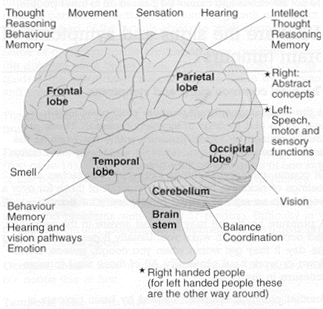
Each cerebral hemisphere is divided into four areas, known as lobes: the frontal, parietal, temporal and occipital lobes. Each lobe controls a different range of activities (see the diagram below).
Cerebellum – This is the back part of the brain and is concerned with balance and co-ordination. These activities are carried out automatically (subconsciously) by this area of the brain and are not under a person’s control.
Brain stem – The brain stem controls the basic functions essential to maintaining life, including blood pressure, breathing, heart beat and also eye movements and swallowing. It is the bottom part of the brain and connects the cerebral hemispheres to the spinal cord.
Page last modified: 02 November 2005