Secondary cancer in the lymph nodes
This information is about secondary cancer in the lymph nodes. This describes the situation where cancer cells have spread to the lymph nodes from a cancer that began elsewhere in the body.
The lymphatic system
The lymphatic system is one of the body’s natural defences against infection. It is made up of organs such as the bone marrow, thymus and spleen as well as lymph nodes (sometimes called lymph glands) all over the body that are connected by a network of lymphatic vessels.
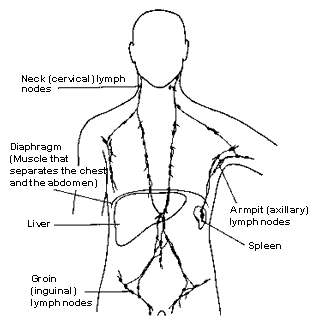
Cancer in the lymph nodes
Cancer can develop in the lymph nodes in two ways. It can either start there: a primary cancer, or it can spread into the lymph nodes from a primary cancer elsewhere in the body. If cancer spreads into the lymph nodes from another part of the body, this is known as secondary or metastatic cancer. Cancer that starts in the lymph nodes themselves is called lymphoma.
How cancers can spread
Cancerous tumours are made up of millions of cells. Some of these cells may break away from the primary cancer and travel in the bloodstream or the lymphatic system to another part of the body. They can stay dormant in such places for many years or can grow into secondary tumours.
Cancer found in lymph nodes in a part of the body far away from an original primary tumour is usually recognised as being a secondary rather than a new primary cancer because under a microscope, the cells will look like cells from the original type of cancer. For example, when a lung cancer has spread to the lymph nodes the cells in the lymph nodes look like lung cancer cells.
In some people, when the original tumour is diagnosed, doctors will also remove some nearby lymph nodes. It is important to know whether a primary cancer has spread to any nearby lymph nodes, because it helps the doctors to estimate the risk of the cancer coming back, and to decide whether further treatment is necessary.
Signs and symptoms
The most common sign of cancer cells in the lymph nodes is that one or more of the lymph nodes becomes large or feels hard. However, if there are only a small number of cells in the lymph nodes, they may feel quite normal and it is only possible to tell that a cancer is present by removing part, or all, of the lymph node and examining the cells in a laboratory. It is important to remember that lymph nodes can be enlarged for other reasons, such as infections.
Sometimes a lymph node, or group of nodes, may appear larger than they should be on a scan, such as an ultrasound scan, CT scan or MRI scan. This may be a sign that there is a secondary cancer in the lymph nodes.
How it is diagnosed
The diagnosis of a secondary cancer in the lymph nodes is usually carried out by removing a lymph node, or nodes, under general anaesthetic (known as an excision biopsy).
Alternatively, a sample of cells (a needle biopsy) may be taken from an enlarged lymph node, using a fine needle attached to a syringe. The needle biopsy is usually done in a clinic and does not need a general anaesthetic.
The cells can then be sent to the laboratory to be examined under the microscope by a pathologist (a doctor who can diagnose illness by looking at cells).
If your doctors feel that the enlarged lymph nodes (or those seen on a scan) are quite clearly linked to the primary cancer, it may not be necessary to remove a node or take a biopsy.
Treatment
The treatment for a cancer that has spread to the lymph nodes depends on the individual situation, including the person’s general health and type of primary cancer. It may include surgery, chemotherapy, radiotherapy, hormonal therapy or a combination of these treatments.
Sometimes, cancer cells may be found in lymph nodes near to the primary tumour during surgery to remove the cancer. In this situation, treatment such as chemotherapy may be suggested. This is because if a primary cancer has spread to the nearby lymph glands it increases the risk that the cancer may have spread to other parts of the body. Chemotherapy can reduce the chance of the cancer coming back for some people.
Your feelings
Being told that the cancer has spread to the lymph nodes can be a shock and it is important to discuss any questions, fears and treatment options with your doctor or nurse.
CancerBACUP has a section on the emotional effects of cancer, which has helpful advice on dealing with the feelings and emotions that you may have.
References
This section has been compiled using information from a number of reliable sources including;
- Oxford Textbook of Oncology (2nd edition). Souhami et al. Oxford University Press, 2002.
- Cancer and Its Management (4th edition). Souhami and Tobias. Oxford Blackwell Scientific Publications, 2003.
- The Textbook of Uncommon Cancers (2nd edition). Raghavan et al. Wiley, 1999.
For further references, please see the general bibliography.
Page last modified: 06 February 2006
- Q&As
- Related information