The lungs
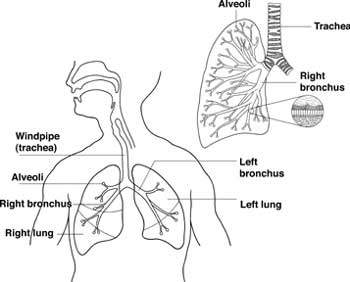
When you breathe in, air passes from your nose or mouth through the windpipe (trachea), which divides into two tubes (airways), one going to each lung. These are known as the right and left bronchus and they divide to form smaller tubes called bronchioles, which carry air through the lungs. At the end of the bronchioles are millions of tiny air sacs called alveoli. In the alveoli, oxygen is absorbed from the air and passes into the bloodstream to be circulated around the body.
Carbon dioxide is a waste gas that must be removed from the body. It passes from the bloodstream into the alveoli and is then breathed out by the lungs.
The right lung has three main areas (known as lobes) and the left lung has two lobes.
Many lung cancers start in the cells lining the bronchi and are called carcinomas of the bronchus or bronchogenic carcinomas.
Page last modified: 02 November 2005