Further tests for diagnosing brain tumours
At the hospital you may have to have some of the following tests. Your doctor will select the most suitable tests for your particular situation and symptoms.
Brain MRI (magnetic resonance imaging) scan
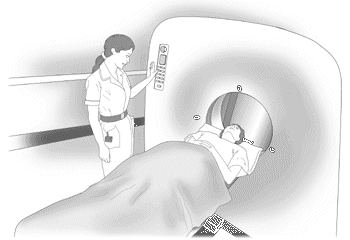
This scan uses a magnetic field to build up cross-sectional pictures of your brain. Before the test, some people are given an injection of dye into a vein in the arm to improve the pictures. During the test you will be asked to lie very still on a couch inside a long chamber for up to an hour. This can be unpleasant if you don’t like enclosed spaces; if so, it may be helpful to mention this to the radiographer. The MRI scanning process is also very noisy, but you will be given earplugs or headphones to wear.
The cylinder is a very powerful magnet, so before entering the room you should remove any metal belongings. People who have metal heart monitors, pacemakers or some types of surgical clips cannot have an MRI because of the magnetic fields.
Brain CT (computerised tomography) scan
This is a series of x-rays, which builds up a three-dimensional picture of the inside of the head. During the test you will be asked to lie with your head inside an opening in the scanner. The scan is painless but takes longer than an x-ray (from 5–10 minutes). It may be used to identify the exact area and size of the tumour. Most people who have a CT scan are given an injection of a liquid into a vein, to allow particular areas of the brain to be seen more clearly. The injection may make you feel hot all over for a few minutes. Before having the injection, it is important to tell your doctor and the person doing this test if you are allergic to iodine or have asthma or diabetes.
You will probably be able to go home as soon as the scan is over.
Skull x-ray
Very rarely, brain tumours may show up on an x-ray picture. The test is simple and painless, but you will have to lie on a couch in the hospital’s x-ray department and keep your head still for a few minutes.
Chest x-ray
A chest x-ray will usually be done to make sure that your lungs are healthy and to look for a possible primary tumour in the lung.
PET (Positron emission tomography) scan
This type of scan provides a picture of brain activity by giving an injection of a sugar-like substance (glucose) which is attached to a tiny amount of radioactivity. The injection is given into a vein in the back of your hand. Tumours normally absorb more of the glucose and the radioactivity shows up on the scan.
A PET scan may help to tell whether a tumour is growing and whether it is cancerous (malignant) or benign. After the injection is given through a small tube in a vein in the back of your hand, you may be asked to lie quietly in a dark room with your eyes closed. You will then be taken to the scanning room and asked to lie on a couch with the scanning ring around you. The dose of radiation you receive is no more than a normal x-ray.
PET scans are only available in a few hospitals and you may have to travel to a hospital some distance away from your home, to have one.
Brain angiogram (or arteriogram)
An angiogram shows up the structure of blood vessels and may show the position of the tumour within the brain. This may be useful information if an operation is planned. First a small tube (catheter) is inserted into an artery (usually in the groin) under local or general anaesthetic. When the catheter has been passed into the correct artery, a dye is injected and a series of x-rays are taken as the dye flows through the brain’s blood vessels. You may need to be admitted to hospital overnight for an angiogram, as it is usually necessary for you to be given a drug to make you drowsy or to have an anaesthetic for the test.
Electroencephalogram (EEG)
This is a recording of the electrical activity within the brain. During the test, wires connected to small plastic discs are attached to your head using a special gel. The recorded nerve impulses are then printed out on paper. The test takes about an hour. It is safe and completely painless. Your hair does not need to be cut and the gel will wash out easily afterwards.
Biopsy
It is often necessary for the doctor to take a small part of the tumour (a biopsy) to find out exactly what type of tumour you have (see Surgery for more information).
Page last modified: 02 November 2005