What are cancers of the head and neck?
Cancer can occur in any of the tissues or organs in the head and neck.
Cancers of the oral cavity
Cancers of the oral cavity can develop on the lips or in the mouth itself. Cancer can occur inside the mouth in the tongue, the hard palate (the roof of the mouth), the gums, the floor of the mouth (under the tongue) and the inner lining of the lips and cheeks (sometimes referred to as the buccal mucosa).
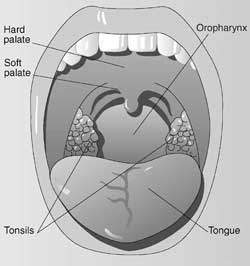
Oropharyngeal cancer
This develops in the oropharynx, the part of the throat that sits directly behind the mouth (see the diagram above). It includes the soft palate (the soft part of the roof of the mouth), the base of the tongue (the part you cannot see), the side walls of the throat (where the tonsils are found) and the back wall of the throat (also called the posterior pharyngeal wall).
Cancer of the nose
Cancers can develop in the skin of the nostril and the lining of the nose. The highest part of the throat, which lies behind the nose, is called the nasopharynx (see the diagram). Cancers that occur here are known as nasopharyngeal cancer.
Alongside the nose, in the bones of the face, lie air spaces known as the sinuses (or paranasal sinuses). Cancers can develop in the linings of these areas too.

Cancer of the ear
Cancers of the ear are uncommon. Most develop in the skin of the ear. They can develop in the structures deep inside the ear, but these cancers are very rare.
Cancer of the eye
Cancers can develop in the skin of the eyelids. Cancers are very unusual in the eye itself. When they do occur, they are usually a type called ocular melanoma. CancerBACUP has seperate information on ocular melanoma.
Occasionally a cancer of the lymph nodes, called lymphoma, can develop behind the eye. In very rare cases, cancer may spread into the eye, from a cancer elsewhere in the body, for example breast cancer.
Some cancers of the head and neck area are not covered by this section because we have separate information about them. These include cancers of the thyroid gland, larynx (voicebox) and salivary glands, as well as the paranasal sinuses, the nasopharynx and ocular melanoma.
Page last modified: 02 November 2005