Barrett’s oesophagus
Barrett’s oesophagus
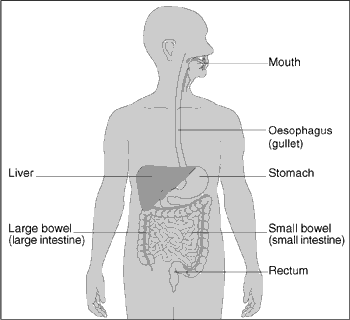
Barrett’s oesophagus is a condition in which abnormal cells develop on the inner lining of the lower part of the gullet (oesophagus). The oesophagus is the muscular tube that carries food from the mouth to the stomach.
Barrett’s oesophagus is not a cancerous condition, but over a long period of time it can occasionally lead to cancer developing in the lower part of the oesophagus. A cancer happens when cells in the affected area continue to grow and reproduce and become increasingly abnormal. Approximately 0.5–1% of people in the UK have Barrett’s oesophagus; however very few people with this condition go on to develop cancer (about 1% each year).
Causes
The main cause of Barrett’s oesophagus is juices from the stomach ‘splashing’ up into the oesophagus. The stomach produces acid, and the stomach juices also contain bile and proteins, which help to digest food. The stomach is lined by tissue that is resistant to acid, but the oesophagus is not. Normally, a valve at the bottom of the oesophagus prevents acid from splashing up into the gullet. However, some people have a weak valve, which allows the acid to flow backwards into the oesophagus (reflux).
The acid may inflame and irritate the oesophagus, and in some people will cause symptoms of pain and heartburn. This is often referred to as reflux oesophagitis.
Certain factors can make people more likely to have reflux, and these include being overweight, smoking and excessive alcohol consumption. For some people spicy, acidic, or fatty foods can cause reflux. Reflux is often also caused by a hiatus hernia (in which a small piece of the stomach is displaced and pokes through the sheet of muscle which divides the chest from the abdomen).
The pre-cancerous changes in the cells are also sometimes called dysplasia. Dysplasia can be either low-grade, or high-grade depending upon how abnormal the changes are, with high-grade being the most abnormal.
Signs and symptoms
Some people have no symptoms at all and the Barrett’s oesophagus is discovered during tests for other medical conditions. The most common symptom is ongoing heartburn and indigestion. Other symptoms include feelings of sickness (nausea), being sick (vomiting) and difficulty swallowing food. Less commonly, there may be blood in the vomit or stools (bowel motions). Some people have pain on swallowing food.
If you experience any of these problems on a regular basis it is advisable to visit your family doctor (GP).
How it is diagnosed
Your GP will examine you and may refer you to the hospital for a procedure known as an endoscopy to examine the lining of your oesophagus.
The endoscopy may be carried out by a doctor or specialist nurse, and enables the oesophagus to be examined using a thin flexible tube called an endoscope. If necessary, small samples of cells are taken, which can be examined to see if they are normal. These are known as biopsies.
The endoscopy can usually be done as an outpatient, but occasionally an overnight stay in hospital is necessary. Once you are lying comfortably on the couch, you may be given a local anaesthetic spray to numb the back of your throat and reduce any discomfort during the test. Alternatively, you may be given a sedative to make you feel sleepy. The sedative is usually injected into a vein in the arm. The doctor or nurse then passes the endoscope down your oesophagus.
An endoscopy can be uncomfortable but it is not painful. After a few hours the effect of the sedative or anaesthetic will wear off and you will be able to go home. You should not drive for several hours after the test and, if possible, you should arrange for someone to travel home with you. You should not try to swallow anything for four hours, until the local anaesthetic has worn off. Some people have a sore throat afterwards: this is normal and usually disappears after a couple of days. If it does not, it is advisable to contact your doctor at the hospital. You should also tell your doctor if you have any chest pain.
Surveillance
Sometimes, people with Barrett’s oesophagus are advised to have their condition checked at regular intervals in order to pick up any further changes. This is known as surveillance and usually involves regular endoscopies and biopsies. At present it is not known how useful surveillance is. This is because of the small number of people with Barrett’s oesophagus who actually go on to develop oesophageal cancer. It will be some time before the benefits and possible disadvantages of regular endoscopies become clear.
Depending on the degree of abnormality and the policy at your hospital, the endoscopies may be repeated at intervals between 3 months and 3 years.
It may be helpful to discuss this with your specialist.
If you are having regular endoscopies and you notice any change or worsening of your symptoms between appointments, it is a good idea to contact your specialist.
Treatment
Sometimes it is possible to reduce the reflux without treatment. Losing weight (if necessary), stopping smoking or drinking less alcohol may help. Eating small meals at regular intervals or avoiding foods that aggravate the symptoms can also help to reduce reflux.
Medicines
You may be given medicines known as proton pump inhibitors (PPI), to decrease the production of stomach acid. This will help to reduce any symptoms that you have. Once the symptoms are controlled, the dose of your PPI may be reduced to a level that keeps the symptoms from recurring.
Surgery
Surgery can be carried out to help strengthen the valve at the bottom of the oesophagus to prevent further acid reflux, or to remove the affected area.
Strengthening the valve Strengthening the valve at the bottom of the stomach usually involves surgery performed through a small cut made in the skin of the chest (known as keyhole surgery). You may need to stay in hospital for a few days and will have several small cuts in the area after the surgery, which heal over after a few days. Occasionally it may be possible to strengthen the valve during an endoscopy. An electrical current can be passed through the valve which causes scarring, which tightens the valve. Alternatively stitches can be placed in the valve or it can be injected with a substance that helps it to tighten.
An operation known as fundoplication is another way of strengthening the valve at the bottom of the oesophagus. During the operation the top of the stomach (the fundus) is wrapped and sutured around the lower end of the oesophagus. This procedure reinforces the lower end of the oesophagus and should help to reduce acid reflux. Fundoplication may involve a large incision in the abdomen (a laparotomy) or it can be done using a laparoscope, which will only involve small cuts in the abdomen.
An operation to repair a hiatus hernia may also help to reduce acid reflux.
Removing the affected area If a biopsy shows that there are continuing changes in the cells lining the lower end of the oesophagus that may progress to cancer, your specialist may suggest that you consider having surgery to remove the affected area, or other treatments that can destroy the abnormal cells. Treatments to destroy these cells include photodynamic therapy and cold coagulation (see below).
Surgery involves removing the section of the oesophagus that contains the abnormal cells. The stomach is then joined to the remaining length of the oesophagus. After your operation you are likely to spend a short period of time in the intensive-care unit. You will have a drip put into a vein in your hand or arm until you are able to eat and drink again. You may also have a naso-gastric (NG) tube in place. This is a fine tube that passes down your nose into your stomach or small intestine and allows any fluids to be removed so that you don’t feel sick. It also helps the area of the operation to heal. You may feel afraid to swallow for a short time and may have a bad taste in your mouth. Mouthwashes can help to relieve this.
At first you will probably be given only sips of liquid until your doctor is satisfied that the join in the oesophagus is healing. It will be a few days before you are able to drink normally. Gradually, you will also be able to eat normally again.
Some surgeons will also place a small feeding tube directly into the small bowel at the time of surgery to feed you while you recover. This is usually removed after you have started to swallow normally.
Sometimes, surgery to remove only the affected area of the lining of the oesophagus may be carried out during endoscopy. This type of surgery is known as endoscopic mucosal resection. It is a smaller operation than the surgery mentioned above and you will need a few days to recover from it. This type of surgery may be followed by photodynamic therapy or cold coagulation (see below).
Photodynamic therapy
Photodynamic therapy is only done in specialist centres. It uses laser light combined with a light-sensitive drug (sometimes called a photosensitising agent) to destroy the abnormal cells. Doctors are still researching how useful photodynamic therapy may be in treating Barrett’s oesophagus. Your specialist can advise whether this treatment is appropriate in your situation.
Cold coagulation
A chemical is sprayed onto the abnormal area during endoscopy. The chemical freezes the area and destroys the abnormal cells. Doctors are working to identify how useful it will be in treating Barrett’s oesophagus and it is currently only available in specialist treatment centres. Your specialist can advise whether this treatment is appropriate for you.
Your feelings
It is often difficult to find information and support when you are diagnosed with a condition such as Barrett’s oesophagus. You may have concerns about whether you need surveillance, medication or perhaps an operation. It is important to discuss these concerns with the doctors and nurses caring for you.
You may have many different emotions including anxiety and fear. These are all normal reactions and are part of the process that many people go through in trying to come to terms with their condition. Many people find it helpful to talk things over with their doctor or nurse. Close friends and family members can also offer support.
References
This section has been compiled using information from a number of reliable sources including;
- Oxford Textbook of Oncology (2nd edition). Eds. Souhami et al. Oxford University Press, 2002.
- Cancer and Its Management (4th edition). Souhami and Tobias. Oxford Blackwell Scientific Publications, 2003.
- The Textbook of Uncommon Cancers (2nd edition). Eds. Raghavan et al. Wiley, 1999.
- Guidance on the use of Proton Pump Inhibitors in the Treatment of Dyspepsia. National Institute of Clinical Excellence (NICE), June 2000.
For further references, please see the general bibliography.
Page last modified: 06 February 2006
- Q&As