Melanoma of the eye (Ocular melanoma)
This information is about a rare type of cancer called ocular melanoma (melanoma of the eye). You may also find it helpful to read CancerBACUP’s general information about malignant melanoma.
What is ocular melanoma?
Ocular melanoma is melanoma of the eye. Melanoma is a cancer that develops from cells called melanocytes. Melanocytes produce the dark-coloured pigment melanin, which is responsible for the colour of our skin. These cells are found in many places in our body including the skin, hair and lining of the internal organs, including the eye.
Most melanomas begin to grow in the skin, but it is also possible for a melanoma to begin in other parts of the body, such as the eye.
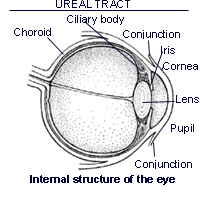
Within the eye itself, melanoma can develop in one of several places (see diagram). The most common type of ocular melanoma is uveal melanoma. This means it occurs along the uveal tract (the dark ring on the diagram) of the eye, which includes the choroid, ciliary body and iris.
The choroid is part of the lining of the eyeball and is dark-coloured (pigmented) to prevent light being reflected around the inside of the eye. The ciliary body extends from the choroid and focuses the eye by changing the shape of the lens. The iris is the clearly visible coloured disc at the front of the eye, which controls the amount of light entering the eye. All these structures are heavily coloured with melanin.
Melanoma can also occur in the thin lining over the white part of the eye (the conjunctiva) or on the eyelid, but this is very rare.
Ocular melanoma is the most common type of cancer to affect the eye, although, generally, it is still quite rare. Approximately 350 new cases of ocular melanoma are diagnosed each year in the UK. The incidence of ocular melanoma increases with age, and most are diagnosed in people in their 60s.
Causes
This is a rare type of tumour and as for many other forms of cancer the exact cause is unknown. It is known that exposure to ultraviolet (UV) rays (either from the sun or sunbeds) increases the risk of developing melanoma of the skin. People whose skin burns easily are most at risk: typically, people with fair skin, fair or red hair and blue eyes. However, it is not yet known whether there is any link between UV ray exposure and the development of melanoma of the eye.
Signs and symptoms
Symptoms include blurred vision, flashing lights, shadows and misting of the lens of the eye (cataract). Often no symptoms are noticed until the tumour is quite large.
All of these symptoms are common to other conditions of the eye, but it is generally possible for an eye specialist (ophthalmologist) to diagnose these tumours quite simply and painlessly. Occasionally a biopsy (taking a small sample of tissue) is needed to confirm a diagnosis.
How it is diagnosed
A number of tests may be done to diagnose ocular melanoma, including:
- Ophthalmoscopy A small hand-held microscope (ophthalmoscope), similar to those used by opticians during routine eye tests, is used to look at the inside of the eye. This is likely to be the first test that you have
- Ultrasound scan A small device which produces sound waves is rubbed over the skin around the eye area. The echoes are then converted into a picture by a computer
- Fluorescein angiography A special dye, called flourescein, is injected into a vein in the arm. In a few seconds, the dye travels to the blood vessels inside the eye. A camera with special filters that highlight the dye is used to photograph the flourescein as it circulates through the blood vessels in the retina and choroid
- CT (computerised tomography) scan A CT scan takes a series of x-rays to build a three-dimensional picture of the inside of the head. The scan is painless but takes 10 minutes, longer than a standard x-ray. It may be used to find the tumour within the eye or to check for any spread of the disease
- MRI (magnetic resonance imaging) scan This type of scanner uses magnetism instead of x-rays to form a series of pictures of the inside of the head. The test can take about 30 minutes and is completely painless, although the machine is noisy and you will be given earplugs or headphones to wear
- Biopsy A small sample of tissue may be taken from the suspicious area and examined under a microscope. However, this is not necessary for most ocular melanomas because they have a distinctive appearance and can usually be recognised easily from the x-rays and scans.
Treatment
A number of different treatments are used for ocular melanoma depending on the size, cell type and position of the tumour, as well as other factors such as your general health, age and level of vision in both eyes. The aim of the treatment is to destroy the cancer cells, stop the cancer coming back, and save as much of your vision as possible.
Radiotherapy
This type of treatment uses high-energy rays to destroy the cancer cells while doing as little harm as possible to normal cells. Radiotherapy may be given either from outside the body (external radiotherapy) or from within (internal radiotherapy). Radiotherapy may be the only treatment or it may be given after surgery. Recent developments in radiotherapy have made it possible to preserve sight in the eye, either completely or partly.
External radiotherapy In external radiotherapy a beam of radiation is directed to the area of the tumour. The treatment is normally given as small doses, called fractions, over a few days. Different types of radiotherapy machines can be used. One, called a Cyclotron, is specifically used to treat eye tumours. This machine directs a proton radiation beam precisely at the affected area, causing as little radiation exposure as possible to the surrounding healthy eye tissue. Before the treatment, a minor operation is carried out to attach small tags to various parts of the eye. The tags act as markers for the radiation beam.
Internal radiotherapy This treatment is given by placing a radioactive source (called a plaque) close to the tumour. This normally involves a stay in hospital of up to a week. The radioactive plaque is placed close to the tumour in the eye under general anaesthetic. Another operation is carried out to remove it when the treatment is finished. Certain precautions need to be taken while the plaque is in your eye. You will need to stay in one room and each member of staff and your visitors will only be allowed in for a short time each day. This is to reduce any unnecessary exposure to radiation. Once the radioactive source is removed no precautions will be necessary, as the radiation will no longer be present.
Transpupillary thermotherapy (TTT)
This can be used to treat very small ocular melanomas or as an additional treatment after radiotherapy. The tumour is heated with a special type of laser beam. Cancer cells are more susceptible to heat than normal cells and so will be destroyed. Several treatments are normally needed.
Surgery
Depending on the size and position of the tumour, it may be possible to remove it without needing to remove the eye. However, if the cancer is growing rapidly, is large or painful, surgery to remove the eyeball may be the most appropriate treatment. This is called enucleation. For many people, this suggestion can be quite shocking and a lot of discussion may be needed with the doctors involved before the decision to go ahead is taken. You can have an artificial eye (prosthesis) made that matches your remaining eye. An implant can be inserted which makes the artificial eye move realistically.
Research trials
Research into treatments for ocular melanoma is ongoing and advances are being made. Cancer doctors use clinical trials to assess new treatments. Before any trial is allowed to take place an ethics committee must have approved it and agreed that the trial is in the interest of patients.
You may be asked to take part in a clinical trial. Your doctor must discuss the treatment with you so that you have a full understanding of the trial and what it means to take part. You may decide not to take part or to withdraw from a trial at any stage. You will then receive the best standard treatment available.
CancerBACUP has a section that explains how clinical trials are set up and answers common questions that people have about them.
Follow-up
After your treatment is completed, you will have regular check-ups and possibly scans or x-rays. These will probably continue for several years. If you have any problems, or notice any new symptoms between these times, let your doctor know as soon as possible.
For people whose treatment is over apart from regular check-ups, CancerBACUP’s section on adjusting to life after cancer treatment gives useful advice on how to keep healthy and adjust to life after cancer.
Your feelings
You may experience many different emotions including anger, resentment, guilt, anxiety and fear. These are all normal reactions and are part of the process many people go through in trying to come to terms with their illness.
CancerBACUP has a section that discusses the emotional effects of cancer and how to deal with them.
References
This section has been compiled using information from a number of reliable sources including;
- Oxford Textbook of Oncology (2nd edition). Souhami et al. Oxford University Press, 2002.
- Cancer and its Management (4th edition). Souhami and Tobias. Oxford Blackwell Scientific Publications, 2003.
- The Textbook of Uncommon Cancers (2nd edition). Raghavan et al. Wiley, 1999.
- Cancer: Principles and Practice of Oncology (7th edition). DeVita et al. Lippincott Williams and Wilkins, 2005.
For further references, please see the general bibliography.
Page last modified: 06 February 2006
- Q&As
- Related information
- Current clinical trials