Small bowel cancer
Small bowel cancer
Cancers affecting the small bowel are rare, making up less than 5% of all bowel cancers.
The small bowel forms part of the digestive system and extends between the stomach and the large bowel (or colon). The small bowel is divided into three main parts: the duodenum, the jejunum and the ileum.
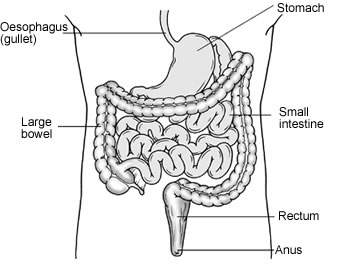
The small bowel folds many times to fit inside your abdomen and is approximately 5 metres (15 feet) in length. It is responsible for the breakdown of food to allow vitamins, minerals and nutrients to be absorbed into the body. Although the small bowel makes up three-quarters of the digestive system, cancers in this area are rare.
There are four main types of small bowel cancer and they are named after the cells that they start from. The types are adenocarcinoma, sarcoma, carcinoid and lymphoma.
Adenocarcinoma These tumours start in the lining or internal skin layer of the bowel. They are the most common type of small bowel cancer and usually appear within the duodenum.
Sarcoma Leiomyosarcomas are sarcomas that usually grow in the muscle wall of the small bowel. These more commonly occur in the ileum. Another, rare type of sarcoma is gastrointestinal stromal tumour (GIST), which can develop in any part of the small bowel.
Carcinoid Carcinoid tumours arise in the special cells that make hormones within the small intestine. These tumours also appear more commonly in the ileum and sometimes within the appendix.
Lymphoma These tumours start in the lymph tissue of the small bowel. The lymph tissue is part of the body’s immune system. Usually small bowel lymphomas are of the type known as non-Hodgkin’s lymphoma, and appear more commonly in the jejunum or ileum.
CancerBACUP has separate information that give more detail about soft tissue sarcomas and non-Hodgkin’s lymphomas, and carcinoid tumours.
Occasionally a small bowel cancer may be a secondary cancer. This means that it has spread from a primary cancer somewhere else in the body.
What causes small bowel cancer?
The cause of most small bowel cancers is unknown. However, some people with nonュmalignant (non-cancerous) bowel conditions may be at higher risk of developing small bowel cancer. These include Crohn’s disease, coeliac disease and Peutz-Jegher’s syndrome and also polyposis. Small bowel cancer is not infectious and cannot be passed on to other people.
Signs and symptoms
The symptoms of small bowel cancer are often vague and difficult to diagnose. They may include any of the following:
- blood in the stools (bowel motion)
- dark /black stools
- vague crampy abdonimal pain
- weight loss
- diarrhoea.
These symptoms may be caused by a number of conditions other than small bowel cancer, but symptoms which are severe, get worse or last for a few weeks should always be checked by your doctor.
Occasionally the cancer can cause a blockage (obstruction) in the bowel, which may be complete or partial. The symptoms of this are vomiting, constipation, griping pain and a bloated feeling in the abdomen.
Sometimes a blockage in the small bowel can cause the bowel to burst. This is a serious condition that usually occurs suddenly and will need to be treated with surgery. The symptoms include severe pain, shock (a drop in blood pressure) and abdominal swelling.
How is it diagnosed?
Your doctor (GP) will examine you and arrange for further tests that may be necessary. Your GP will need to refer you to a hospital specialist for these tests and for expert advice and treatment. The doctor at the hospital will take your full medical history and do a physical examination. You will probably have a blood test and a chest x-ray to check your general condition. You may also be asked to take a sample of your stool (bowel movement) to the hospital so that it can be tested for blood. The following tests are commonly used to diagnose small bowel cancers.
Endoscopy or colonoscopy
These tests allow the doctor to look inside the duodenum and the upper part of the jejunum, or the lower part of the ileum. The test may be done in the hospital outpatient department or on a ward.
You will be asked to lie on your side and given a mild sedative to help you relax. The doctor gently passes a thin tube either down your throat and through your stomach (endoscopy), or into your back passage (colonoscopy). With the help of a light on the inside of the tube the doctor can see any abnormal areas. If necessary, a small sample of the cells can be taken (called a biopsy) for examination under a microscope by a pathologist.
Unfortunately these tests do not reach some areas of the jejunum or the ileum so different tests are needed to find tumours in these areas.
Barium x-rays
This is a special x-ray, sometimes called a barium meal or barium follow-through, of the small bowel. It will be done in the hospital x-ray department. For this test it is important that the bowel is empty so that a clear picture can be seen. Your hospital will give you instructions, but it is likely that on the day before your test you will be asked to take a laxative and drink plenty of fluids, to help to empty the bowel.
On the day of your barium x-ray, you should not have anything to eat or drink. You will be asked to drink a fluid that contains barium, a substance that shows up white on x-ray. The doctor can watch the passage of the barium through the whole of the small bowel on a screen and any abnormal structure of the small bowel can be seen.
For a couple of days after the test you may find that your stools are white. This is the barium passing out of your body and is nothing to worry about. The barium can also cause constipation so you may need to take a mild laxative for a couple of days.
Other tests
CT scans, ultrasound scans and other kinds of x-rays may detect a small bowel tumour but are not always successful. However, these tests may be used to look at other areas of your body to see if there is any evidence that the cancer has spread.
Sometimes it is difficult to get a clear picture of the small bowel, and biopsies cannot always be taken, so diagnosis may occasionally be made during an operation.
Staging
The stage of a cancer is a term used to describe its size and whether it has spread beyond its original site. Knowing the particular type and the stage of the cancer helps the doctors to decide on the most appropriate treatment.
Cancer can spread in the body, either in the bloodstream or through the lymphatic system. The lymphatic system is part of the body’s defence against infection and disease. The system is made up of a network of lymph glands (also known as lymph nodes) that are linked by fine ducts containing lymph fluid. Your doctors will usually check the lymph nodes close to the small bowel in order to help find the stage of the cancer.
- Stage 1 The cancer is contained within the lining of the small bowel or has spread into the muscle wall, but has not begun to spread to the lymph nodes or other parts of the body.
- Stage 2 The cancer has spread through the muscle wall and may affect other nearby structures such as the pancreas.
- Stage 3 The cancer has spread to nearby lymph nodes.
- Stage 4 The cancer has spread to nearby lymph nodes and also to other parts of the body such as the lungs.
If the cancer comes back after initial treatment this is known as recurrent cancer
Treatment
This will depend upon a number of things, including your age, your general health, the position, size and exact type of cancer, and whether it has spread to any other areas. The treatments for each type of small bowel cancer may vary.
Surgery
Surgery is the main treatment for cancer of the small bowel. Surgery may be used to remove the tumour and join the bowel back together. It may also be used if there is a blockage within the bowel.
Often it is possible to remove the whole tumour during an operation but this is not the case for everyone. The position of the tumour within the bowel and how much of the bowel is involved will determine how extensive the surgery is. It may be necessary to remove part of the stomach, colon, the gall bladder or the surrounding lymph nodes during the surgery.
Usually the bowel can be joined together again during surgery, but if for some reason this is not possible, the end of the bowel will be brought out on to the skin of the abdominal wall. This opening is called a stoma and the proceure is known as an ileostomy. A bag is worn over the stoma to collect the stool. Sometimes the ileostomy will be temporary and a further operation to rejoin the bowel can be done a few months later. Occasionally the ileostomy may be permanent, but this is very rare.
CancerBACUP’s Cancer Support Service can give you further information about having an ileostomy. The stoma care nurse at the hospital will help you to look after the stoma for the first few days, and can give you support and information on caring for your stoma when you go home
If the cancer is large and has caused a blockage in the small bowel it is sometimes possible to bypass the tumour to relieve the symptoms, even if complete removal of the tumour is not possible. After a major operation you may have to stay in an intensive care ward for a couple of days before being moved back to a general ward.
Your surgeon will explain your operation to you and can answer any questions that you may have. Sometimes, however, the surgeon may not know exactly what can be done until during the operation.
After surgery
When part of the small bowel has been removed or bypassed, it may sometimes be necessary to have a special diet, supplements or medicines. This will depend upon the extent of the surgery, and is intended to help with the digestion and absorption of food. Your doctor or nurse will explain this to you.
Radiotherapy
Radiotherapy is the use of high-energy rays to destroy cancer cells while doing as little harm as possible to normal cells.
It is not commonly used in the treatment of small bowel cancers. However, it may be used following surgery or in combination with chemotherapy, depending upon the individual situation.
Chemotherapy
Chemotherapy is the use of anti-cancer (cytotoxic) drugs to destroy cancer cells.
Occasionally chemotherapy may be given in combination with radiotherapy or surgery or on its own, to treat cancer of the small bowel. Chemotherapy is not suitable for every situation and its effectiveness in small bowel cancer is still being researched.
Biological therapies
Interferon is another type of drug treatment that may be used for some types of small bowel cancers, usually carcinoid tumours. Interferon activates the body’s own immune system to fight the cancer. It is given as an injection under the skin.
Other drugs or newer approaches to treating cancer may also be given in certain situations. These may help to control the cancer or any symptoms that occur.
Follow-up
After your treatment has been completed, your doctor will ask you to go back to hospital for regular check-ups and x-rays or scans. These are good opportunities to discuss with your doctor any worries or problems that you may have. However, if you notice any new symptoms or are anxious about anything else in the meantime, contact your doctor or the ward sister for advice.
For people whose treatment is over apart from regular check-ups, CancerBACUP’s section on adjusting to life after cancer treatment gives useful advice on how to keep healthy and adjust to normal life.
Clinical trials
Research into treatments for cancer of the small bowel is ongoing and advances are being made. Cancer doctors use clinical trials to assess new treatments.
You may be asked to take part in a clinical trial. Your doctor must discuss the treatment with you so that you have a full understanding of the trial and what it means to take part. CancerBACUP has a section that explains how clinical trials are set up and answers some of the most common questions about them.
Your feelings
During diagnosis and treatment, you may have many different emotions including anger, resentment, guilt, anxiety and fear. These are all normal reactions and are part of the process many people go through in trying to come to terms with their illness.
References
This section has been compiled using information from a number of reliable sources including;
- Oxford Textbook of Oncology (2nd edition). Souhami et al. Oxford University Press, 2002.
- Gastrointestinal Oncology: Principles and Practice. Kelsen et al. Lippincott Williams and Wilkins, 2002.
- The Textbook of Uncommon Cancers (2nd edition). Raghavan et al. Wiley, 1999.
For further references, please see the general bibliography.
Page last modified: 06 February 2006
- Q&As
- Related information