Further tests for large bowel cancer
If the biopsy shows that there is a cancer in the large bowel, further tests are often needed to find out the size and position of the cancer, and to see whether it has spread. This process is called staging, and may take some time. The results will help you and your doctor to decide on the best treatment for you.
General information
Sometimes, during and after the period of treatment, these tests may be done again to check on your progress.
Although tests are useful in diagnosing bowel cancer, no one test can give all the necessary information. For example, sometimes even modern scans cannot pick up tiny areas of cancer. Occasionally, other medical conditions show similar results, making it difficult to decide what is and is not cancer.
Doctors have to think about all the information they get from the different tests and examinations, along with your symptoms and medical history. For this reason, it is often best for the doctor to discuss test results with you personally.
Blood tests
You will probably have blood tests to assess your general health, and also to check for a particular protein that is sometimes produced by bowel cancer cells. The protein is called carcinoembryonic antigen (CEA).
Chest x-ray
X-rays are often taken to check the health of your heart and lungs.
Abdominal ultrasound scan
An ultrasound scan uses sound waves to look at internal organs, such as the liver and the inside of the abdomen, to see whether there is any spread of the cancer to other organs. You will usually be asked not to eat or drink for at least 6 hours before the test.
Once you are lying comfortably on your back, a gel is spread onto your abdomen. A small device, like a microphone, which produces sound waves, is passed over the area. The sound waves are then converted into a picture by a computer. The test only takes a few minutes.
In some situations you may have a probe (like a tube) inserted into the rectum to produce ultrasound scans. This is known as an endoscopic ultrasound (EUS).
CT (computerised tomography) scan
A CT scan takes a series of x-rays which builds up a three-dimensional picture of the inside of the body. It can show the size of the tumour in the bowel and whether it has spread beyond the bowel. The scan is painless but takes longer than an ordinary x-ray (from 10 to 30 minutes).
CT scans use a small amount of radiation, which will be very unlikely to harm you and will not harm anyone you come into contact with. You will be asked not to eat or drink for at least 4 hours before the scan.
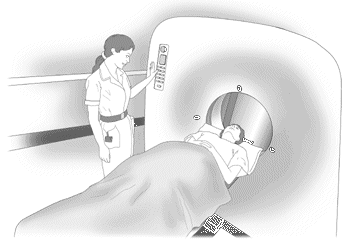
You may be given a drink or injection of a dye, which allows particular areas to be seen more clearly. For a few minutes, this may make you feel hot all over. If you are allergic to iodine or have asthma you could have a more serious reaction to the injection, so it is important to let your doctor know beforehand.
Just before the scan, a similar liquid is also passed into your back passage through a small tube. Although this may be unpleasant at the time, it makes sure that the best possible picture is produced. Once you are in position, the scan will be taken.
You will probably be able to go home as soon as the scan is over.
MRI (magnetic resonance imaging) scan
This test is similar to a CT scan, but uses magnetism instead of x-rays to build up cross-sectional pictures of your body. It can help to show the stage of the cancer and can give the surgeon information to help them plan the operation.
Some people are given an injection of dye into a vein in the arm to improve the image. During the test, you will be asked to lie very still on a couch inside a long chamber for about 30 minutes. This can be unpleasant if you don’t like enclosed spaces. If so, it may help to mention this to the radiographer. The MRI scanning process is also very noisy, but you will be given earplugs or headphones to wear. You can usually take someone with you into the room to keep you company.
The chamber is a very powerful magnet, so before going into the MRI room you should remove any metal belongings. People who have heart monitors, pacemakers or certain types of surgical clips cannot have an MRI because of the magnetic fields.
PET (positron emission tomography) scan
Pet scans are a new type of scan and how effective they are in the diagnosis of bowel cancers is not yet known. These scans are not available in all hospitals and you may have to travel to a specialist centre to have one. They are not often necessary but you can discuss with your doctor whether one would be useful in your case.
A PET scan uses low-dose radioactive sugar to measure the activity of cells in different parts of the body. A very small amount of a mildly radioactive substance is injected into a vein, usually in your arm. A scan is then taken. Areas of cancer are normally more active than surrounding tissue and show up on the scan.
It will take several days for the result of your tests to be ready, and a follow-up appointment will be arranged for you before you go home. Waiting for results can be a difficult time and you may need support from your family or from an organisation.
Page last modified: 02 November 2005
- Q&As