Anaplastic large cell lymphoma
This information is about a specific type of non-Hodgkin’s lymphoma known as anaplastic large cell lymphoma. It should ideally be read with CancerBACUP’s general information about non-Hodgkin’s lymphoma.
Anaplastic large cell lymphoma
Anaplastic large cell lymphoma is an uncommon type, accounting for about 2% of all cases. It can occur at any time from childhood to old age but is most common in children and young adults. It is about twice as common in men as in women. The lymphoma is usually made up of T-lymphocytes, although in some cases the type of cell making up the lymphoma is unclear: this is known as null-cell type.
Causes
The causes of anaplastic large cell lymphoma are not known. Anaplastic large cell lymphoma, like other cancers, is not infectious and cannot be passed on to other people.
Signs and symptoms
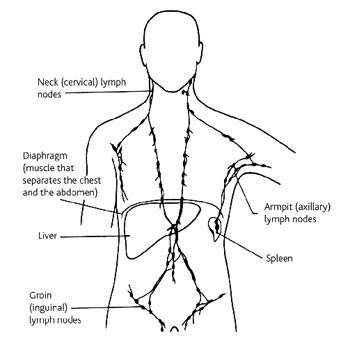
The first sign of the condition is often a painless swelling in the neck, armpit or groin, caused by enlarged lymph nodes. Often, more than one group of nodes is affected. This lymphoma may also occur in skin and sometimes in other organs such as the lungs, liver, bone marrow or bones. Some people have loss of appetite and tiredness.
Other symptoms, which are known as B symptoms, include night sweats, unexplained high temperatures, and weight loss.
How it is diagnosed
A diagnosis is made by removing an enlarged lymph node, or part of it, and examining the cells under a microscope. This is known as a biopsy and you will be referred to a surgeon for this procedure. It is a very small operation and may be done under local or general anaesthetic. Biopsies may also be taken from other body tissues.
Additional tests, including blood tests, x-rays, scans and bone marrow samples, are then used to get more information about the type of lymphoma and how far it has spread in the body. This information is used to help decide which treatment is most appropriate.
Staging
The ‘stage’ of NHL describes how many groups of lymph nodes are affected, where they are in the body and whether other organs such as the bone marrow or liver are involved.
Stage 1 The lymphoma is only in one group of lymph nodes in one particular area of the body.
Stage 2 More than one group of lymph nodes is affected, but all the affected nodes are contained within either the upper half or the lower half of the body. The upper half of the body is above the sheet of muscle underneath the lungs (the diaphragm) and the lower half is below the diaphragm.
Stage 3 Lymphoma is present in lymph nodes in both the upper and lower parts of the body (i.e. in lymph nodes both above and below the diaphragm). Your spleen is considered as a lymph node in this staging system.
Stage 4 The lymphoma has spread beyond lymph nodes to other lymphatic organs – for example, to sites such as the bone marrow, liver or lungs.
The stage usually includes the letter A or B, which describes whether any B symptoms are present or not (e.g. stage 2B). Sometimes the lymphoma can start in areas outside the lymph nodes, and this is represented by the letter E, which stands for extranodal (e.g. stage 3AE).
Grading
For practical purposes non-Hodgkin’s lymphomas are also divided into one of two groups: low and high-grade. Low-grade lymphomas are usually slow-growing and high-grade lymphomas tend to grow more quickly.
Anaplastic large cell lymphoma is a high-grade lymphoma. This means that it is faster-growing and usually needs prompt treatment with chemotherapy.
Treatment
Chemotherapy
Chemotherapy is the use of anti-cancer (cytotoxic) drugs to destroy cancer cells.Anaplastic large cell lymphoma usually needs intensive treatment with chemotherapy. A combination of drugs is given into a vein through injections or drips. Several different combinations of drugs have been used to treat this condition and they appear to be equally successful.
This type of lymphoma usually responds well to chemotherapy, and the lymphoma may seem to disappear completely. This is known as a remission. However, there is a risk that it may come back in years to come. In this situation further chemotherapy can be given to try to bring it under control.
Radiotherapy
Radiotherapy is the use of high-energy rays to destroy cancer cells while doing as little harm as possible to healthy cells. It may be used alone when the lymphoma cells are contained in one area of lymph nodes (stage 1). However, radiotherapy is more commonly given after chemotherapy.
High-dose treatment with stem cell support
High-dose chemotherapy with bone marrow or stem cell infusions have been used for some people with this type of lymphoma. This type of treatment involves having very intensive chemotherapy and sometimes radiotherapy.
As side effects can be severe, some types of high-dose treatment are not given to people over the age of 45–50, while others can be given to people of up to 65 years who are fit enough. The intensity of the treatment increases the risks of serious side effects for people over this age.
Steroid therapy
Steroids are drugs which are often given with chemotherapy to help treat lymphomas. They also help you to feel better and can reduce feelings of sickness.
Clinical Trials
New treatments for anaplastic large cell lymphoma are being researched all the time, and you might be invited by your doctor to take part in a clinical trial to compare a new treatment against the best available standard treatment. Your doctor must discuss the treatment with you and have your informed consent before entering you into any clinical trial.
CancerBACUP has a section on cancer research trials which you may find helpful.
Support
The need for practical and emotional support will of course be individual. For some people with anaplastic large cell lymphoma, life may seem little affected; for others the diagnosis of cancer may be a cause of great fear and distress. If you would like to discuss the condition, its treatment or the practical and emotional problems of living with anaplastic large cell lymphoma please contact CancerBACUP’s Support Service.
References
This section has been compiled using information from a number of reliable sources including:
- Oxford Textbook of Oncology (2nd edition). Souhami et al. Oxford University Press, 2002.
- Wintrobe’s Clinical Haematology (11th edition). Lee et al. Williams and Wilkins, 2004.
- Malignant Lymphoma. Hancock et al. Arnold, 2000.
- British Committee for Standards in Haematology guidelines on nodal non-Hodgkin’s lymphoma, draft 2. August 2002.
- Improving outcomes in Haemato-oncology. National Institute of Clinical Excellence, November 2003.
For further references, please see the general bibliography.
Page last modified: 02 November 2005