Ductal carcinoma in Situ (DCIS)
This information is about ductal carcinoma in situ (DCIS). It should ideally be read with CancerBACUP’s general information about breast cancer.
DCIS
DCIS stands for ductal carcinoma in situ. This means that in a part of your breast the cells lining the milk ducts (the channels in the breast that carry milk to the nipple) are cancerous, but stay contained within the ducts without growing through into the surrounding breast tissue. DCIS may affect just one area of the breast but can be more widespread and affect different areas at the same time. Sometimes DCIS may be described as pre-cancerous, pre-invasive, non-invasive or intraductal cancer.
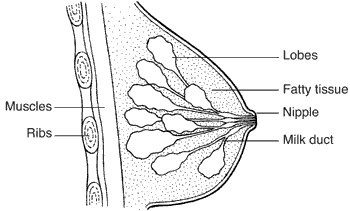
If DCIS is left untreated, it may, over a period of years, begin to spread into (invade) the breast tissue surrounding the ducts. It is then known as invasive breast cancer. It is important to remember that although DCIS should be treated to prevent it developing into an invasive breast cancer, it is not harmful at this stage. Not every woman with DCIS will go on to develop breast cancer if it is left untreated, but it is not possible to predict which women with DCIS will develop breast cancer.
There are three grades of DCIS – low, intermediate and high. The grade refers to how abnormal the cells look under the microscope and gives an idea of how quickly the cells may develop into an invasive cancer (or how likely it is that the DCIS will come back after surgery). Low-grade DCIS has the lowest risk of developing into an invasive cancer and high-grade the greatest risk.
Causes of DCIS
The exact causes of DCIS are not known but certain women appear to be at a higher risk of developing it. This includes women who have never had any children, or who had them late in life, women who started their periods at a young age or who had a late menopause, and women who have a strong family history of breast cancer. The risk factors of developing DCIS are similar to those of developing invasive breast cancer.
Signs and symptoms
Most women with DCIS have no signs or symptoms and only know they have it because it can be seen on a mammogram. Because more women are having mammograms, as part of the national breast screening programme, DCIS is diagnosed much more often than it was in the past.
The DCIS usually shows up on a mammogram as an area where tiny specks of calcium have collected in the breast ducts (known as microcalcification). It is important to know that most microcalcification is not DCIS or cancer.
A small number of women with DCIS may have symptoms such as a breast lump or fluid (discharge) coming out of the nipple.
After the mammogram
Once an abnormal area has been found on the mammogram, the doctor has to obtain a sample of cells from the area so that they can be examined under a microscope. This is done by removing a sample of tissue (a biopsy) using a special needle called a core biopsy needle. A local anaesthetic will be given to numb the area before the biopsy is taken. Alternatively a fine needle aspiration cytology or FNAC may be used to remove some of the cells. This test uses a fine needle and a syringe to draw out some of the cells.
If there is no obvious lump, mammograms may be used at the same time to ensure that the sample of cells is taken from the correct area. Alternatively, the radiologist may place a wire into the area of abnormal cells to guide the surgeon to the correct piece of tissue when the biopsy is done. This is called wire localisation biopsy.
Treatment
Surgery
The treatment for DCIS depends on its extent (how much of the breast it is affecting) and its grading. The most important part of treatment is the surgical removal of the affected breast tissue, together with an area (margin) of normal breast tissue around it for safety. This operation is called a wide local excision (WLE).
Wide local excision is an example of breast-conserving therapy (only the area of DCIS is removed, rather than the whole breast).
If the area of DCIS is large, and especially if it is large and high-grade, removal of the breast (mastectomy) is considered to be the best treatment for some women. Mastectomy is also the recommended treatment if the DCIS is affecting more than one area of the breast. This cures the condition in virtually all women and no further treatment is necessary, although it is important for the other breast to be checked at least yearly by mammogram.
DCIS does not generally spread to the lymph nodes in the armpit (axilla), but sometimes if the area of DCIS is large or widespread the lymph nodes may be removed during the surgery and checked for cancer cells. This is because for some women there may be an area of invasive cancer cells within the DCIS which could spread into the lymph nodes. Before your operation, your doctor will discuss with you whether it is necessary to remove any of your lymph nodes.
Radiotherapy
After breast-conserving surgery, radiotherapy is sometimes used to treat the remaining breast tissue. It is most commonly used if the area of DCIS was high-grade. Radiotherapy is normally given every weekday for 3–6 weeks. The exact role of radiotherapy is still being tested in research trials.
Hormonal therapy
Sometimes the cancer cells within the area of DCIS have oestrogen receptors on their surface. This is known as oestrogen-receptor-positive DCIS. This means that the cells rely on the hormone oestrogen to grow. Oestrogen is a female hormone that is naturally produced in the body and it can stimulate some breast cancer cells to divide and grow. If you have oestrogen-receptor positive DCIS you may be prescribed a drug called tamoxifen that is designed to counteract the effects of oestrogen. Tamoxifen works by attaching itself to the oestrogen receptors on the surface of the cancer cells. This prevents oestrogen from entering the cells and can stop the cells from growing or dividing.
Tamoxifen may reduce the risk of developing invasive breast cancer for women with oestrogen-receptor-positive DCIS who have had their DCIS treated by wide local excision, with or without post-operative radiotherapy.
Follow-up
After breast-conserving surgery there is a small risk of DCIS coming back. If you have breast conservation therapy, you will be offered yearly follow-up appointments, so that if the DCIS comes back it is detected as early as possible. If you notice any change in the breast between these appointments you can arrange to see the breast cancer specialist earlier. If the DCIS does come back, mastectomy is likely to be the chosen treatment. Breast reconstruction can be done at the same time.
If you have had DCIS it is important to have your unaffected breast checked regularly by mammogram (at least every three years).
Research trials
Research into treatments for DCIS is ongoing, and advances are constantly being made. Cancer doctors use clinical trials to assess new treatments. Before any trial is allowed to take place, an ethics committee must have approved it and agreed that the trial is in the interest of patients.
You may be asked to take part in a clinical trial. Your doctor must discuss the treatment with you so that you have a full understanding of the trial and what it means to take part. You may decide not to take part or withdraw from a trial at any stage. You will then receive the best standard treatment available.
Your feelings
You may experience many different emotions including anger, resentment, guilt, anxiety and fear. These are all normal reactions and are part of the process many people go through in trying to come to terms with their illness.
Some women find it helpful to talk things over with their doctor or nurse. Close friends and family members can also offer support.
References
This section has been compiled using information from a number of reliable sources including;
- Oxford Textbook of Oncology (2nd edition). Eds. Souhami et al. Oxford University Press, 2002.
- Ductal Carcinoma in Situ of the Breast (2nd edition). Silverstein. Lippincott Williams and Wilkins, 2002.
- Cancer and Its Management (4th edition). Souhami and Tobias. Oxford Blackwell Scientific Publications, 2003.
- Improving outcomes in breast cancer – the research evidence. National Institute of Clinical Excellence, 2002.
For further references, please see the general bibliography.
Page last modified: 02 November 2005